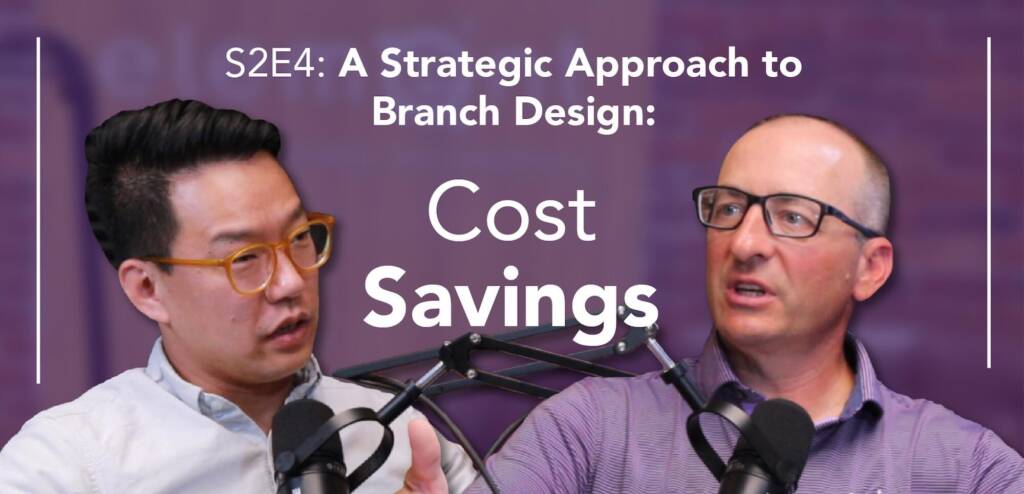
When a bank or credit union takes on a branch project, the focus is usually on how much it will cost to build. But what often gets overlooked is how much can be saved with the right strategy in place. By aligning stakeholders early, tracking budgets with precision, optimizing square footage, and planning sites intelligently, Element creates branches that reduce costs while serving members and customers more effectively.
In this episode of the Bits Matter Podcast, host Doug Ridley sits down with William Foley, co-founder of The Element Group, to discuss where we see the biggest savings come from.
People: Early Alignment Saves Rework
Cost savings start with people, not drawings. When every stakeholder (leadership, designers, contractors, and suppliers) is at the table from day one, projects move faster and avoid costly rework.
This is why Element encourages clients to visit the office during the concept phase. Being around the same table with drawings creates clarity. As William Foley explains, “When everyone is reviewing conceptual drawings together, we confirm budgets, identify long-lead items, and eliminate surprises before they happen.” That upfront alignment sets the tone for a project that stays on track and on budget.
Budgets: Smarter Tracking Saves on Overspending
Running a budget once is never enough. To keep spending aligned, Element revisits budgets multiple times through schematic design, design development, and construction documents. This layered approach, informed by Element’s national cost database and local contractor input, prevents overruns and keeps projects lean without cutting quality.
Space: Smaller Footprints Save
Real estate and construction are the largest costs in branch projects. Smaller footprints bring immediate and long-term savings in construction, staffing, upkeep, heating, and cooling. By leveraging ITMs, teller pods, open design elements, and efficient layouts, Element has helped institutions reduce branches from the traditional 3,000–4,000 square feet down to 2,000, and in some cases, as little as 750. Less space means lower costs and more efficient operations.
Sites: Smart Planning Saves Land and Traffic Costs
Savings don’t stop at the front door. They start the moment a member or customer drives onto the site. The layout of the parking lot, traffic flow, signage, and drive-up lanes all shape the experience before anyone steps inside. Poor site planning can frustrate visitors, reduce efficiency, and lead to expensive fixes once construction is underway.
Element approaches site design as part of the overall branch experience, not as an afterthought. By evaluating land use and traffic patterns early, institutions avoid costly mid-project changes and create a smoother, more welcoming arrival. As William Foley explains, “The first impression starts in the parking lot, not in the lobby.”
Key Cost-Saving Strategies for Leaders
- Save money through stakeholder buy-in from day one
- Keep budgets lean by checking costs at every design stage
- Reduce square footage with smarter layouts and technology
- Save on land and construction by planning sites from the street inward
Smart planning early saves dollars later, while also creating branches that feel more intentional, efficient, and welcoming.
Take the next step
🎧 Listen to the full podcast episode now
📊 Want real numbers? Download our Branch Cost Benchmark Report and see what today’s projects actually cost.
Transcript
Doug Ridley: Welcome to the Bits Matter podcast. I’m your host, Doug Ridley, and today we’re continuing season two, a strategic approach to branch design, with episode four: Cost Savings.
In this episode, I’m joined by William Foley, co-founder of The Element Group and an expert in design-build projects for banks and credit unions. Today, we talk about key points during planning and budgeting, where clients are reducing project costs.
Now let’s get started.
William, let’s talk about cost savings. How are clients saving on their projects?
William Foley: Well, I think the biggest thing in my mind is a team approach. Get everyone involved from day one, from the institution to the financial institution to the designer, to the architect, to the general contractor, to the supplier. So everyone has buy-in from day one.
And then also, once you have everyone’s buy-in, to design a more efficient, well thought-out square foot branch.
Doug Ridley: And that buy-in seems to be also a way to save on time and changes in the future as well.
William Foley: Correct. So everyone understands the conceptual drawing. We’re all looking at it at the same time. We’re confirming the budget works. We’re confirming that there are no long-lead items. We have all of our ducks in a row, per se, to proceed forward.
Doug Ridley: And you know, one thing when we talk about savings and knowing budget that we do is we run the budget throughout the project multiple times to make sure that things are still aligned, that we have no surprises there.
William Foley: And we do a lot of in-house take-offs during early planning, during schematic design and design development, because we have a database of all costs that it takes to design and build a bank throughout the country. So we do that early on, and then as we’re going through the project, we’ll get buy-in from local subcontractors, a local general contractor that understands some of the local costs.
And then we’ll test that in every phase from schematic design, design development, construction documents.
Doug Ridley: Talk to us a little bit more about the square footage piece, because that’s something you and I went back and forth on quite a bit, is just how much more efficient these banks are becoming in smaller spaces. But still being able to serve members and customers well, still be very comfortable for the full-time employees, still meet these branches’ goals.
William Foley: Yeah. We understand technology, and that plays an important role in defining the square footage of the branch. Are we using ITMs or are we using teller pods? We’re not using a traditional teller line. It takes up more space. We’re designing smaller offices with natural light and glass to appear larger. We’re using more vertical space. So we’re taking all those things into consideration to design a smaller square footage footprint to save dollars for our clients.
Doug Ridley: Continuing on with square footage, how are we helping clients just evaluate how much square footage they actually need?
William Foley: Well, we’re kind of looking at what type of services are involved in the branch. How many employees will we need in the branch? How many transactions, what type of functionality, what type of drive-up? We’re taking all that information, plus circulation, back of house, break rooms, restrooms. We’re putting that into our database and helping understand exactly what the square footage should be for the client’s needs.
Doug Ridley: And then for the new technology and for a more efficient branch, Element has, I think, an in-house sort of formula calculation that we run every year as well.
William Foley: Our architects and designers all understand what it takes to define the square footage. So we put that into the database with all the information. And actually, you know, it’s tested and looked at and updated as we look at new branches.
Doug Ridley: About square footage, you know, we’ve talked a lot about the reduction in square footage. Correct? You know, 3,000–4,000 ft² used to be the norm. What are we seeing people get down to nowadays?
William Foley: Right now, if we do the formulas right, and we understand the client needs, we can get down to 2,000 ft² and still have a fully functional branch. And we’ve gotten as low as 750 ft² that still have private offices, still has the ITMs or teller pod, still has technology, a lot of digital in the branch.
Doug Ridley: And I feel like when we talk about square footage, it’s not all just the building. You have to buy the land or lease land, but then it’s also staff as well. That’s full-time employees, heating and cooling the branch. Anything else clients are asking about?
William Foley: Well, a lot of times they’ll come to us and ask, “How much land do I need? I’m looking at a parcel. It’s a quarter acre. What type of facility can I put on that? Because it’s in the right location. I love where it’s located. It’s by the traffic, like it’s by Dunkin Donuts. You know, it has all the checkmarks.” So we’ll look at it and we’ll define it. We’ll look at setbacks. We’ll look at how much drive-up is needed. We’ll go through the square footage analysis and give them a determination: “Oh yes, you could fit 2,000 square feet on this location.”
Doug Ridley: The thing that I’ve seen our designers and architects do is not just the building but also the plot of land as well. Traffic flow, oh, you’re going to want people to come in here. Let’s put the parking lot over here versus the drive-up over here, because you don’t want people crossing.
William Foley: Well, the thing we look at, and a lot of institutions love this about it, is we start from the drive, like the approach to the parking lot. Literally, where is the drive-up, where’s the branding, where’s the signage? So we’re starting our design from the street and working into the building. Literally how a member or a customer is going to first experience the branch as soon as they get into the parking lot.
And that’s why we look at digital signage that’s on the outside, where the drive-up’s located, where the ATM is located, where the ITMs are, what type of branding is on the building—so they have that visual as soon as they pull into the parking lot.
Doug Ridley: Wow. That’s super interesting to think about. We’ve talked so heavily about what the branch experience is once you’re inside, and we do talk about digital signage extending the brand outside. But that idea of what’s the experience as you pull in, don’t you want your member or customer to feel welcome as soon as they pull into the parking lot? And make it easy for them to understand, do I need to do a transaction today? Do I want to go in and close an account? Where do I need to go? Where do I park? How do I get to the drive-up? All those things are defined early on, and that could even be in the critique.
Doug Ridley: And I would have to think that during the critique phase, we’re seeing people not intentionally, but just make mistakes because this is the first time they might be doing this sort of build-up or renovation, whatever that project might be.
William Foley: Exactly.
Doug Ridley: Well, William, thank you for joining us. Any parting thoughts to institutions as they start their 2026 budget planning season?
William Foley: Well, I think the biggest thing is work with someone that has the expertise in the design-build world. If that’s what you’re looking at, have a realistic budget, a realistic timeline, and it will be successful.
Doug Ridley: And that’s a wrap on this week’s episode. A big thanks to William Foley for joining us and sharing ways you can save during your next branch project. If you’re preparing for budget season and unsure where to begin, keep in mind that upfront planning isn’t solely about drawings and numbers. It’s about getting everyone from the financial institution to the architect, contractors, and suppliers involved from day one. A big thank you to our producer, Bryn Baldasaro, with music by the George Brown Band.
Be sure to subscribe and stay tuned for the next episode, where Marc Healy joins us to talk about how the retail mindset influences branch design. Thanks for listening, and we’ll see you next time.