What is Branch Choreography?
In financial services, differentiation rarely comes from the product itself. Checking accounts, auto loans, and credit cards exist everywhere. The real difference is how people feel when they interact with your institution. That experience becomes most visible inside the branch.
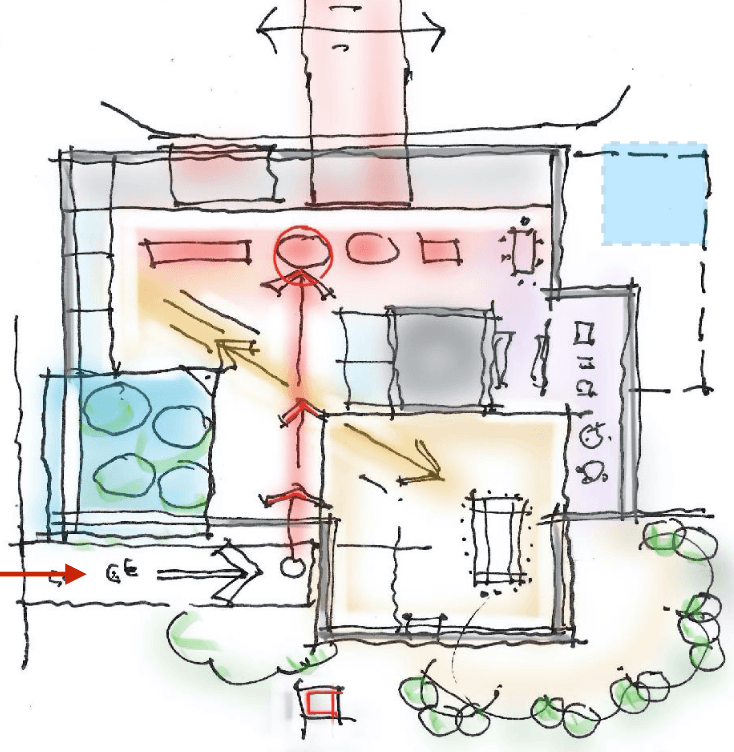
Branch choreography is the intentional design of what happens when a customer or member walks through the door. It defines how employees engage with visitors, how the space supports conversations, and how the overall environment guides the customer and member journey.
Think of the branch as a stage. Employees each play a role, and the interaction between people, technology, and space forms a coordinated experience.
A member walks in. Then what?
For many financial institutions, the answer is unclear. Someone stands in the lobby, unsure where to go or who to speak with. No one makes eye contact. No one greets them. In a highly competitive and commoditized industry, those small moments matter more than most institutions realize. Branch choreography ensures that every interaction inside the branch is intentional, practiced, and designed to create a positive experience.
Why Choreography Matters More in 2026
Branches are seeing fewer visits than in previous decades. Digital banking, AI-driven tools, and remote transactions have significantly reduced routine traffic.
That change raises an important question for financial leaders. If fewer people are visiting the branch, what purpose does the physical environment serve?
The Element Group believes the future of branches is human engagement.
When someone chooses to visit a branch in 2026, it represents an opportunity. They may need advice, reassurance, or help navigating an important financial decision. The value of the branch is no longer the speed of transaction. Technology now handles that efficiently. The branch must justify its existence by delivering something digital channels cannot replicate.
Every visit becomes a moment to strengthen the relationship.
If that moment is missed, the institution loses its advantage. Consumers have many choices, but what they remember when they walk out is how they were treated.
Designing Engagement Zones That Encourage Conversation
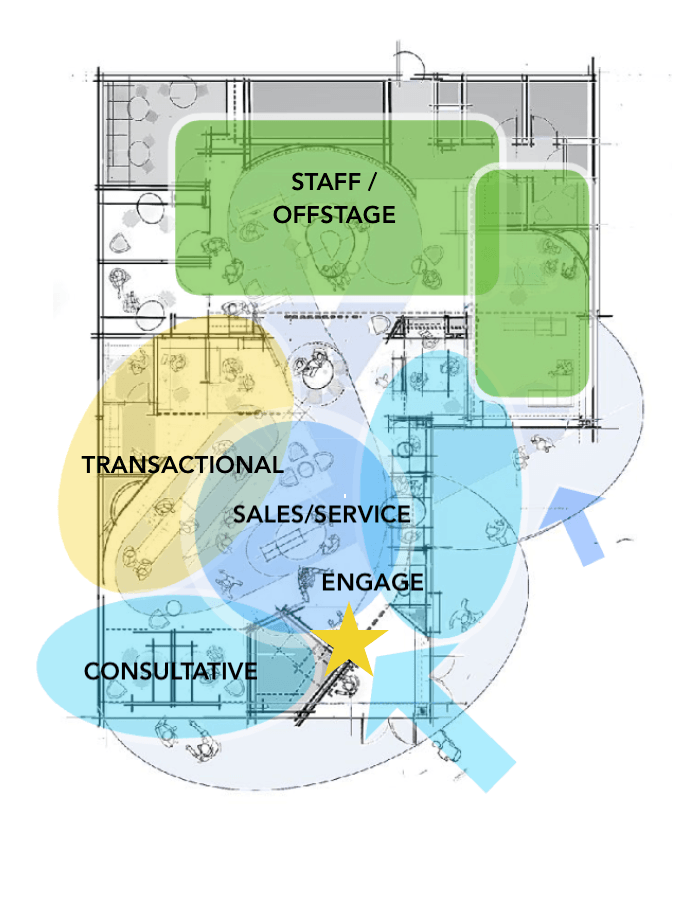
The branch layout should function as a tool that enables employees to engage naturally with members. When space is carefully planned, it encourages conversation rather than transactions alone. Successful branches often include clearly defined engagement zones that support different types of interactions.
Welcome zones create an immediate acknowledgment when someone enters the branch. A simple greeting signals that the member has been seen and valued. Open conversational areas provide comfortable environments for dialogue. These spaces allow employees to learn about goals, life events, and financial needs.
Technology enabled areas allow quick transactions to happen efficiently, freeing employees to focus on higher value conversations. The goal is not to push people through a process. The goal is to create opportunities to talk and learn.
When employees ask thoughtful, open-ended questions, they gain context about the member’s life.
A recent graduate may soon need a car loan.
A young family may be preparing to purchase a home.
A small business owner may be considering expansion.
Those insights create relevance. The branch becomes more of a place for guidance rather than a place for transactions.
Training Choreography
Effective choreography starts with preparation. Teams cannot deliver a thoughtful, consultative experience without practicing how those interactions should unfold. Training and role-playing give employees the opportunity to rehearse the consumer journey before it happens in real time.
During slower periods, teams can use their time wisely and walk through scenarios together. Employees practice greeting members, asking open-ended questions, and navigating different types of conversations. These exercises help staff think through how they would respond to common situations and unexpected ones.
This type of rehearsal builds confidence. It sharpens instincts and helps employees become comfortable initiating meaningful conversations rather than waiting for a customer or member to ask for help.
Just like a performance, each person understands their part in creating a consistent and welcoming environment. At the same time, choreography should never feel scripted in an uncompromising way.
Not every conversation can be planned. Consumers arrive with different needs, questions, and personalities. Employees must be able to adapt in the moment and think on their feet.
That is why choreography works best as a high-level framework rather than a word-for-word script.
The fundamentals remain consistent:
- greet people quickly, ideally within the first 10 seconds
- ask thoughtful questions
- listen carefully
- look for opportunities to advise
With training and repetition, these behaviors become natural. They are confidently guiding conversations that strengthen the relationship between the member and the institution.
Practice Creates Confidence
Just like a performance, choreography improves through rehearsal.
The more teams practice interactions, the more comfortable they become at initiating conversations and identifying opportunities to help members. Employees develop stronger instincts and learn how to transition instinctively from greeting to discovery.
Practice also reinforces the institution’s service philosophy. Employees begin to see themselves not as order takers but as advisors who are responsible for improving a member’s financial wellbeing. Over time, the choreography becomes second nature.
A Retail Mindset for Branch Choreography
Retailers understand something that traditional banking often overlooks. The customer experience begins the moment someone enters the space. Greeting, energy, presence, and accessibility all shape how people feel about the brand.
Financial institutions that adopt a retail mindset design their branches accordingly:
- employees are visible and approachable
- conversations happen naturally
- members feel welcomed rather than processed
This shift requires leadership alignment, thoughtful training, and a branch environment that supports engagement. But the payoff is significant because when the experience feels intentional, members remember it.
What the Future Branch Looks Like
The most successful branches in the coming years will share several characteristics:
- they will have smaller footprints supported by efficient technology
- they will employ highly skilled bankers who are comfortable engaging with members
- they will operate with clearly defined choreography that guides the member journey
- Every visit will be treated as the perfect opportunity to build a relationship.
In a world where financial products are largely the same everywhere, the institutions that stand out will be the ones that design how people feel when they walk through the door. Because in the end, the experience is the differentiator.